
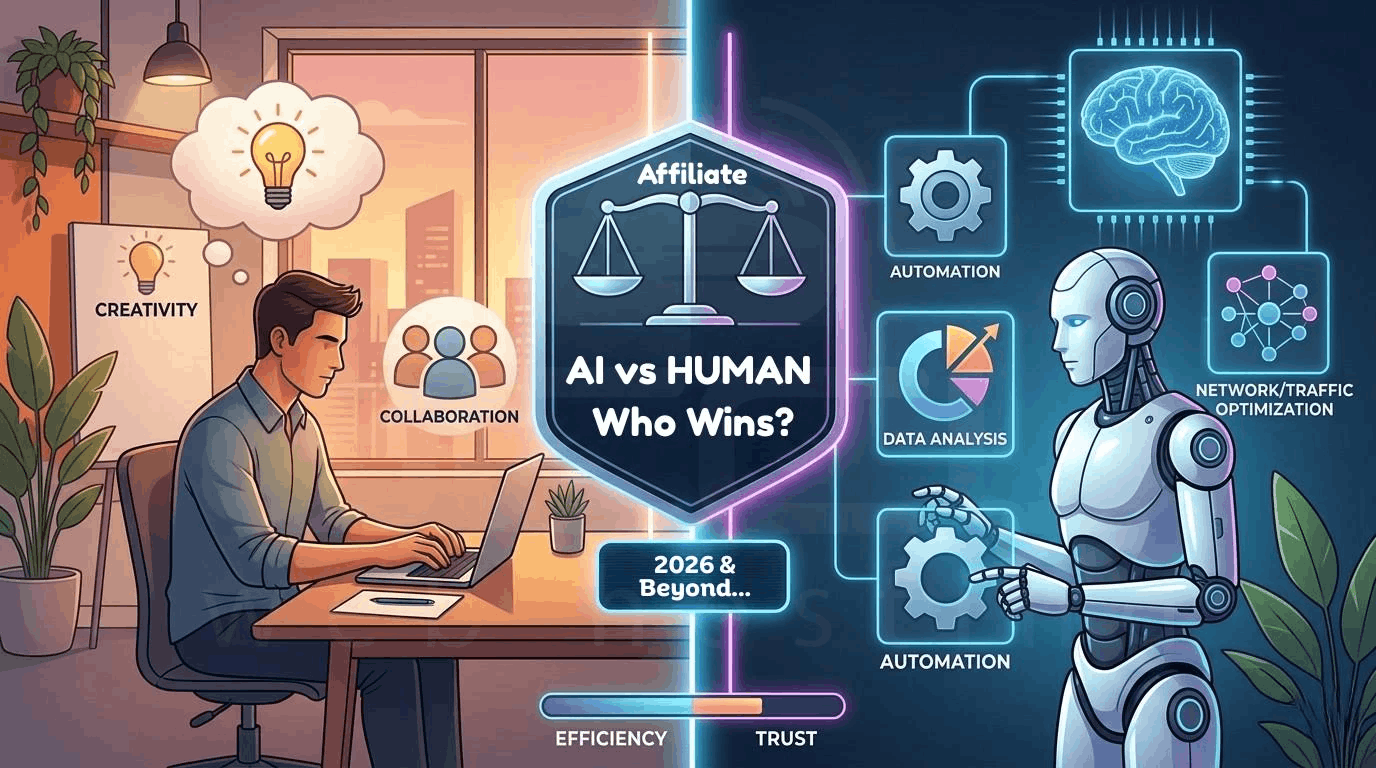
AI is everywhere now, and affiliate marketing is no different. You may find numerous affiliate websites filled with AI-generated reviews and comparison posts, generating content faster than ever. It handles pretty much everything, from choosing which niche to dive into, writing content, boosting traffic with programmatic SEO, tracking performance, and whatnot. All those tasks that required hours of time and effort earlier can be done within minutes.
But as we keep using AI more and more, the question is, will it completely replace human affiliates, or will manual efforts still have the edge?
This article uncovers this by explaining what each does best.
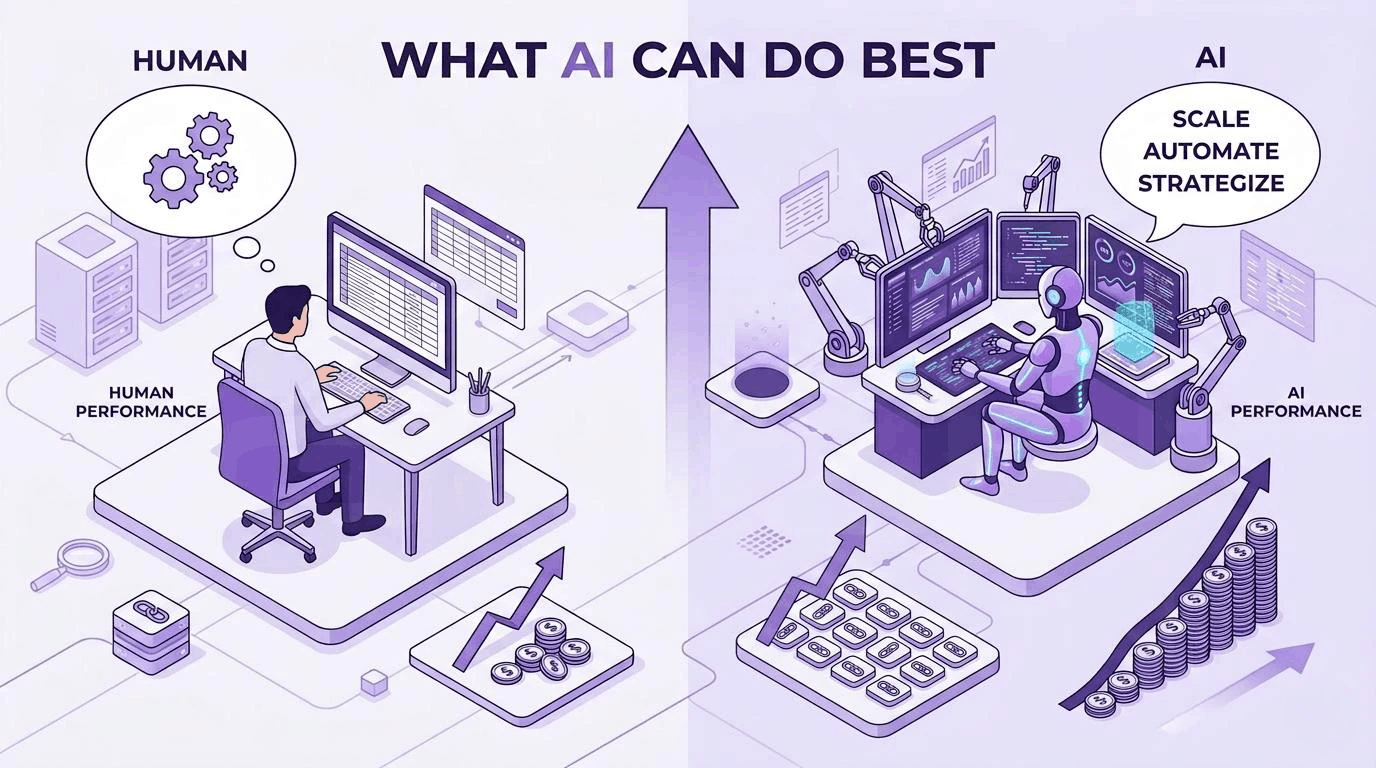
What AI Can Do Best?
Predictive Decision Making
AI doesn’t just analyze past data; it can predict future trends, one of its best advantages. It can forecast which products will convert, what content will rank, and when users are most likely to buy.
Automation
AI can tailor content, emails, data analytics, blogs, run campaigns, allowing 24/7/365 operations, responding to users through chatbots, optimizing funnels and offers for thousands of users individually, something humans simply can’t do manually.
A/B Testing at Speed
AI can run multiple variations of headlines, landing pages, and CTAs simultaneously and instantly optimize based on performance.
→ Read more on A/B Testing for Affiliate Marketing
Multi-Channel Management
AI can manage and sync campaigns across SEO, email, paid ads, and social media simultaneously, with a consistent strategy.
Data-Driven
AI can analyze keyword patterns, search trends, and structure content for SEO, often outperforming leading manual research methods, leading to more consistent performance.
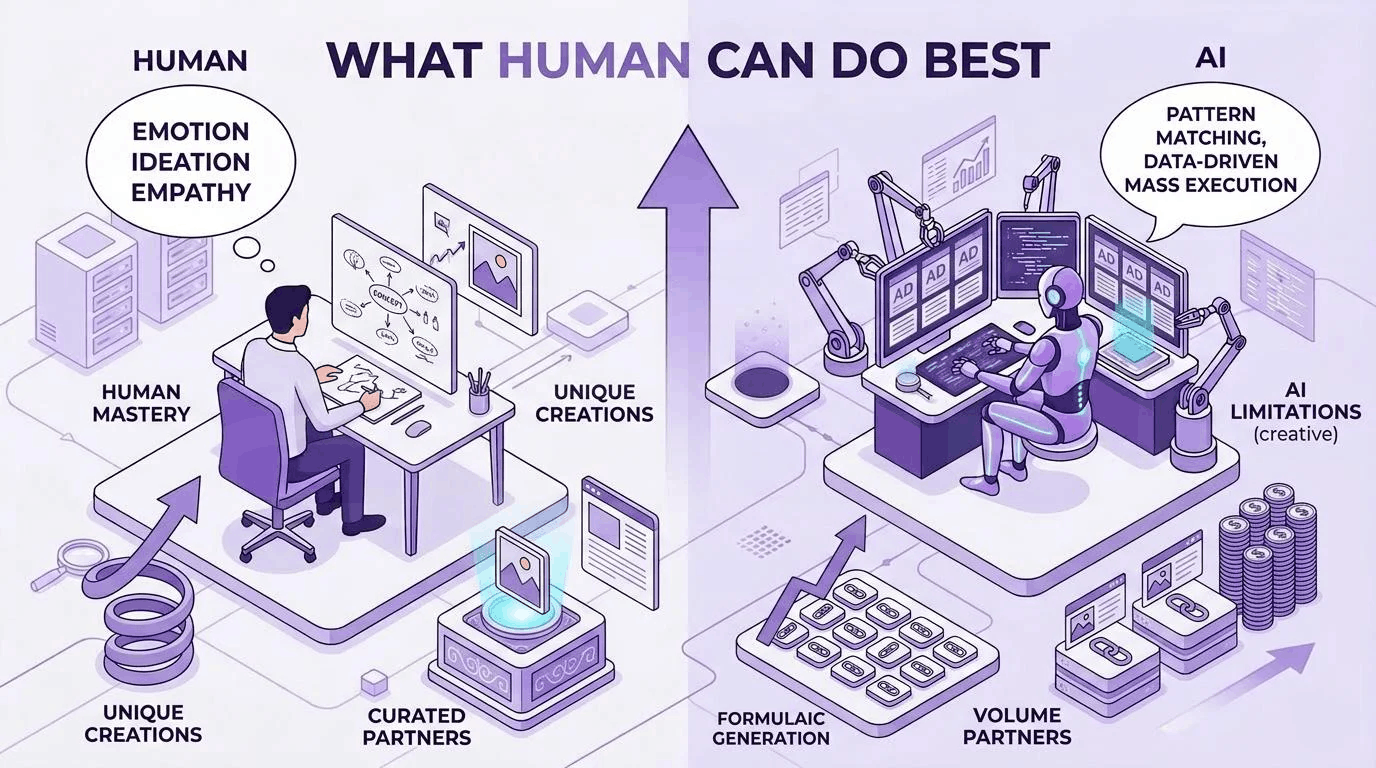
What Humans Can Do Best?
Understanding
Humans don’t just see data; they understand why people behave the way they do. It is crucial for high-converting content.
Creativity & Original Thinking
AI recombines existing data. Humans create new angles, unique hooks, and disruptive campaign ideas.
Ethical Judgment
Humans decide what feels right or wrong for a brand. AI might generate content—but it can’t fully understand brand reputation risks.
Relationship Building
Affiliate success often comes from trust built over time through communities, personal brands, and direct engagement.
Strategic Thinking
AI can execute, but Humans decide direction. Long-term vision, positioning, and differentiation still require human thinking.
Handling Uncertainty & Trends
When something completely new happens (a market shift, a viral trend), humans adapt faster through intuition and creativity.
In affiliate marketing, trust plays a crucial role. Users seek genuine reviews over AI-generated content, making trust essential for success and connection.
Where AI Falls & Humans Win?
- AI can write up reviews, but let’s be real, it has never actually tried the product or service it’s talking about. Everything it spits out comes from what’s already out there. On the other hand, People share their own experiences and honest opinions, which makes their feedback way more believable.
- Sure, AI can copy someone’s style and sound pretty convincing, but it doesn’t actually get emotions. It doesn’t know what excitement feels like or the annoyance of a bad product. Humans tell stories, show empathy, and talk about real-life stuff, and that’s how they connect with people.
- If you’ve read enough AI-generated content, you know it often starts sounding the same across different platforms. That’s because it pulls from the same pool of information, so you keep seeing repeated ideas and nothing really stands out. Humans bring something fresh and new takes and personal stories that can cut through the noise.
- AI also misreads intent, cultural quirks, or sarcasm. It doesn’t really “get” trends or know what a specific group of people might find funny or interesting. Humans naturally understand the context, so their content fits better and makes more sense.
- AI doesn’t have its own opinions; it just rephrases patterns and probabilities. Humans can offer genuine advice, personal recommendations, and insights you can’t find in the data.
- Affiliate marketing is not just about pitching products; it’s about creating a community of loyal followers. AI can not sustain a conversation or build bonds with people over time. Humans dive into conversations, answer emails, build relationships, and stay connected.
- AI’s great at mixing old ideas in new ways, but coming up with something truly original? Not really, it's a thing. People can experiment, try new formats, and get creative with their campaigns.
- AI can only go as far as the data it’s trained on; it can’t break new ground or have unique insights. Humans, though, actually explore and experiment, coming up with ideas that you won’t find in any dataset.
How Successful Affiliates are Leveraging A Hybrid Model
Instead of competing, the smartest affiliates are combining both.
AI can handle speed, automation, and data-driven, repetitive tasks; optimize campaigns; analyze performance; and scale operations effortlessly. On the other hand, humans bring strategy, creativity, storytelling, and the ability to build genuine relationships.
When AI and humans work together, their combined strengths create powerful results, inspiring confidence in hybrid approaches.
For example, AI can generate email drafts, and humans can refine them with personal experience and tone. AI can launch and optimize campaigns, while humans adjust messaging, positioning, and emotional appeal. This collaboration creates a balance between efficiency and authenticity.
The future of affiliate marketing is not choosing between AI and humans - it is combining both. By combining, we get optimum results.
AI will not replace human affiliates - but it will replace affiliates who don’t use AI.
By 2026, the real winners won’t rely solely on automation or manual effort. They will be the ones who know how to combine AI’s efficiency with human authenticity.
Because in the end, people don’t buy from algorithms, they buy from trust.
Comparison Of The Old Manual Way (2020) Vs. The Hybrid Way (2026)
| Features | Manual Way | Hybrid Way |
| Learning | Took long time to pick up tools and skills | Learn faster with help from AI and built-in guidance |
| Content Updates | Had to update old content by hand, not very often | AI keeps content fresh and optimized all the time |
| Competitor Analysis | Slow, limited research | AI quickly checks out multiple competitors at once |
| Error Handling | More room for human mistakes | AI catches most errors, humans double-check for accuracy |
| Content Volume | Didn’t get much done because of time constraints | Can create lots of content without letting quality slip |
| Experimentation | Testing new ideas felt risky and took a while | Try new things faster with AI-backed simulations and tests |
| Time Management | Workload was heavy, and burnout was common | Automation balances the load and eases the pressure |
| Market Trend Detection | Trends took a while to spot | AI finds patterns and spots trends early on |
| Workflow Efficiency | Processes and tools didn’t always fit together | Integrated AI tools make the workflow smooth |
| Global Reach | Manual targeting made it hard to go global | AI support opens up global markets more easily |
| Resource Dependency | Needed a big team to get things done | Smart automation means fewer people, same results |
| Conversion Optimization | Relied on guesswork and old experience | AI gives real-time suggestions to boost results |