
Role of LLMs in Hosting Support Automation
The web hosting industry has changed significantly, with customers expecting 24/7 support, fast resolutions, and personalized assistance. Traditional support teams often struggle to meet these demands efficiently.
Large Language Models (LLMs) such as GPT, Claude, and Gemini are helping hosting providers automate support, improve customer experience, reduce response times, and lower costs. This article explores how LLMs are transforming hosting support automation, including their benefits, use cases, implementation strategies, challenges, and future trends.
Understanding LLMs
Large Language Models are AI systems trained on vast amounts of text data to understand context, language patterns, technical documentation, and conversational interactions.
Unlike traditional chatbots that rely on predefined scripts and decision trees, LLMs can:
-
Understand natural language queries
-
Generate context-aware responses
-
Interpret technical terminology
-
Summarize information
-
Translate content
-
Create documentation
-
Assist with troubleshooting
For hosting companies, this means customers can communicate naturally instead of navigating complex support workflows.
For example, a customer may ask:
"Why is my WordPress website showing a 500 error after updating plugins?"
An LLM can analyze the question, identify common causes, and provide step-by-step troubleshooting guidance.
Why Hosting Support Needs Automation?
Modern hosting providers face several support challenges:
High Ticket Volumes
Hosting companies receive large numbers of support requests related to:
-
Website downtime
-
DNS issues
-
Email configuration
-
SSL certificates
-
Billing inquiries
-
Server performance
-
Website migrations
-
Security concerns
Many of these requests are repetitive and consume valuable support resources.
24/7 Customer Expectations
Customers expect immediate support regardless of time zones. Maintaining large support teams around the clock can be expensive.
Increasing Technical Complexity
Cloud hosting, VPS environments, containerization, and managed hosting services require deeper technical expertise. Support teams must handle increasingly sophisticated issues.
Cost Management
Support departments represent a significant operational expense. Automation helps reduce costs while maintaining service quality.
LLMs address these challenges by providing intelligent, scalable support capabilities.
Key Roles of LLMs in Hosting Support Automation
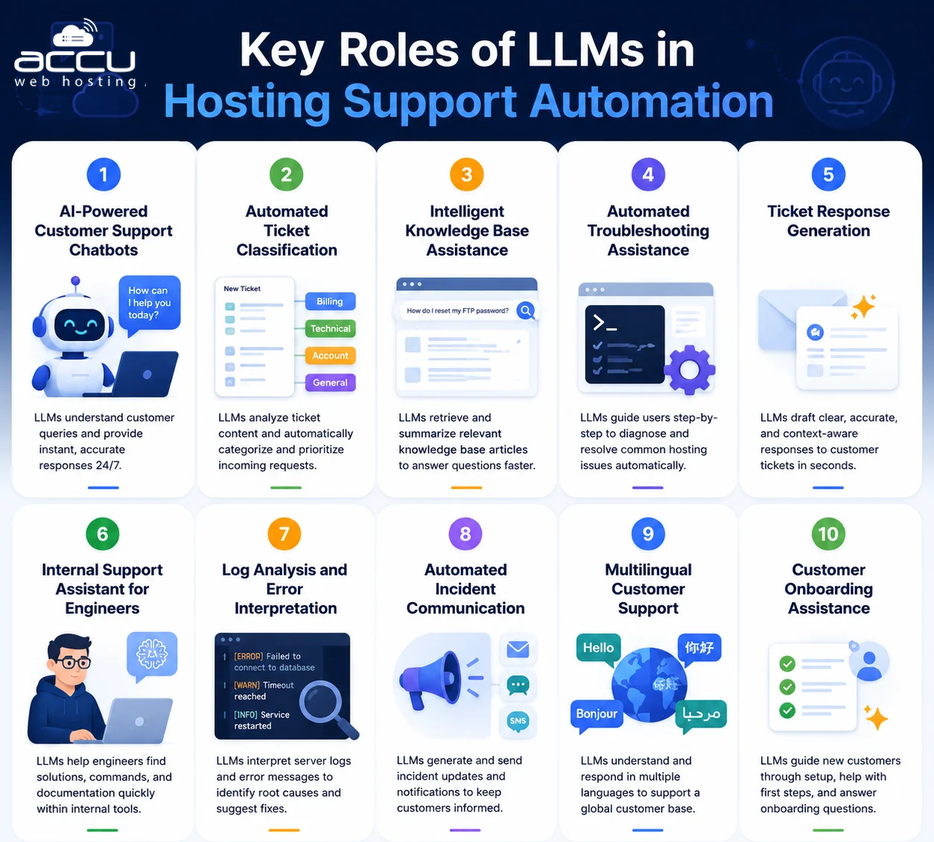
1. AI-Powered Customer Support Chatbots:
One of the most common applications of LLMs is intelligent support chatbots. Traditional chatbots typically follow predefined rules:
-
If a customer asks A, show response B.
-
If the customer selects option C, display answer D.
These systems often fail when customers phrase questions differently. LLM-powered chatbots can understand customer intent regardless of wording.
For example:
-
"My site is down."
-
"Website not loading."
-
"Server unreachable."
-
"Getting connection timeout."
An LLM can recognize that all these statements relate to website availability issues and provide appropriate troubleshooting steps.
Benefits include instant responses, Reduced ticket creation, Better customer satisfaction and continuous availability.
2. Automated Ticket Classification:
Support teams spend considerable time categorizing tickets before they reach the appropriate department. LLMs can automatically analyze incoming tickets and determine Issue type, Severity level, Product category, Required expertise and Priority status.
Example categories Billing, Shared Hosting, VPS Hosting, Dedicated Servers, Email Services, SSL Certificates and Domain Management. Automated classification improves routing accuracy and reduces resolution times.
3. Intelligent Knowledge Base Assistance:
Knowledge bases often contain thousands of articles. Customers frequently struggle to find relevant documentation. LLMs can function as intelligent search assistants by understanding customer questions, searching documentation, extracting relevant information and presenting concise answers.
Instead of forcing customers to browse multiple articles, AI can provide direct answers with links to supporting documentation. This significantly improves self-service success rates.
4. Automated Troubleshooting Assistance:
LLMs can guide users through troubleshooting processes. For example, when a customer reports:
"My email is not working."
The AI can ask follow-up questions. Are you able to send emails?, Are you able to receive emails? Which email client are you using? Are there any error messages?
Based on responses, the AI can recommend solutions such as verifying SMTP settings, checking DNS records, reviewing mailbox storage limits, and resetting passwords. This reduces the workload on support engineers.
5. Ticket Response Generation:
Support agents often spend time writing repetitive responses. LLMs can generate draft responses for Password reset requests, SSL installation guidance, Backup restoration instructions, DNS configuration help and Website migration procedures. Agents can review and edit responses before sending them.
Benefits include faster ticket handling, consistent communication, reduced writing effort and improved productivity.
6. Internal Support Assistant for Engineers:
Hosting companies maintain extensive internal documentation. Support engineers frequently need information related to server configurations, product policies, escalation procedures, troubleshooting workflows.
LLMs can act as internal assistants by providing instant access to organizational knowledge. This helps new employees become productive faster, reduce training time, improve response consistency and increase support efficiency.
7. Log Analysis and Error Interpretation:
Server logs often contain complex technical information. Analyzing logs manually can be time-consuming. LLMs can help interpret apache errors, nginx logs, MySQL issues, PHP errors, Mail server logs and DNS problems. For example, a support engineer can provide a log snippet and receive error explanation, possible causes and recommended actions. This accelerates issue diagnosis.
8. Automated Incident Communication:
When outages occur, hosting providers must communicate updates quickly. LLMs can automatically generate status page updates, customer notifications, incident reports and resolution summaries. This ensures consistent messaging during service disruptions.
9. Multilingual Customer Support:
Hosting companies serve global customers. Hiring support teams for every language is expensive. LLMs can provide multilingual support by translating customer messages
-
Generating responses in multiple languages
-
Maintaining conversation context
This expands global reach without significantly increasing staffing requirements.
10. Customer Onboarding Assistance:
Many customers are unfamiliar with hosting environments. LLMs can guide users through Account setup, Domain configuration, SSL installation, Website deployment, Email setup and Control panel navigation.
Automated onboarding reduces customer frustration and support requests.
Benefits of LLMs in Hosting Support
-
Faster Response Times: Customers receive immediate assistance instead of waiting in support queues. This improves the overall customer experience.
-
Reduced Support Costs: Automation handles repetitive inquiries, allowing support teams to focus on complex issues. Companies can manage larger customer bases without proportional increases in staffing.
-
Improved Customer Satisfaction: Quick and accurate responses lead to better customer experiences and stronger retention rates.
-
Increased Agent Productivity: Support engineers can focus on high-value tasks rather than repetitive ticket handling.
-
Scalability: LLMs can support thousands of simultaneous conversations without performance degradation.
-
Consistency: AI-generated responses maintain consistent quality and messaging across support channels.
Real-World Hosting Support Use Cases
-
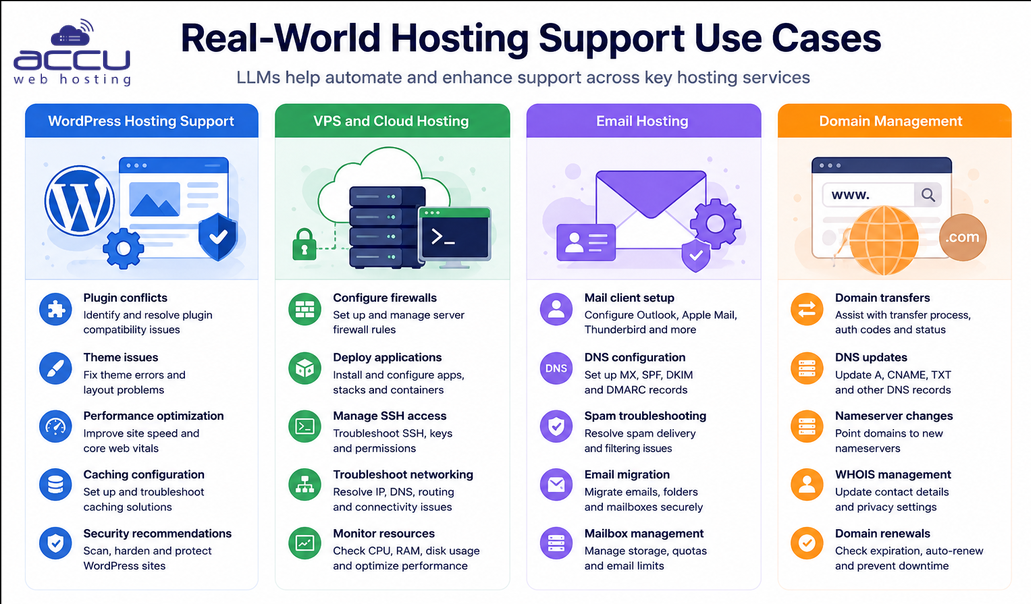
WordPress Hosting Support: LLMs can assist customers with Plugin conflicts, Theme issues, Performance optimization, Caching configuration, and Security recommendations
-
VPS and Cloud Hosting: AI assistants can help users configure firewalls, deploy applications, manage SSH access, and troubleshoot networking issues.
-
Email Hosting: Common support tasks include mail client setup, DNS configuration, spam troubleshooting, and email migration assistance.
-
Domain Management: LLMs can guide customers through Domain transfers, DNS updates, Nameserver changes, and WHOIS configuration.
Integrating LLMs into Hosting Platforms
Successful implementation requires careful planning.
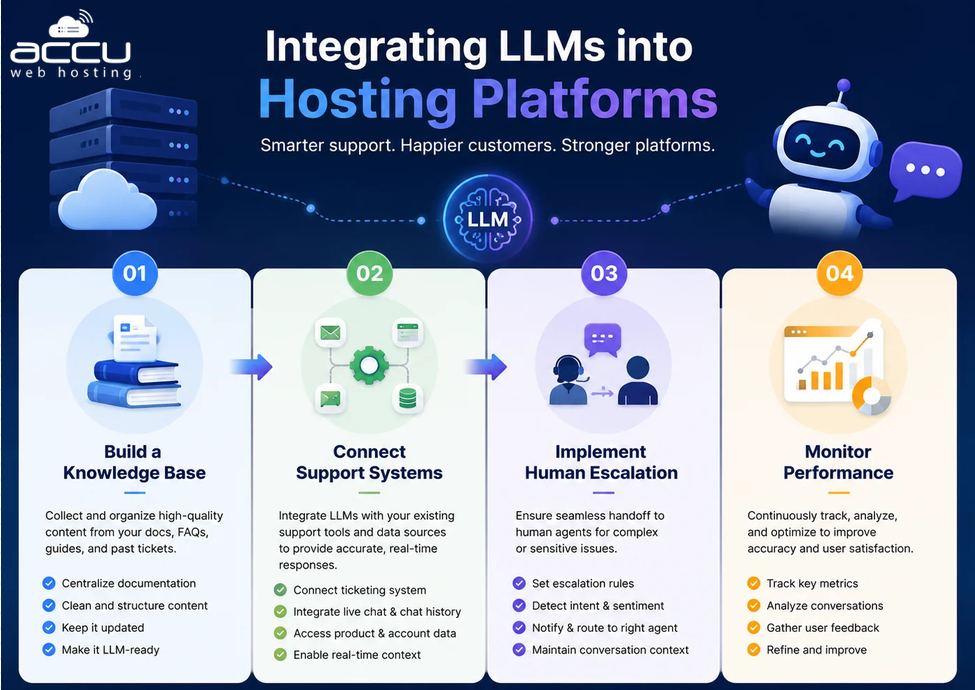
Step 1: Build a Knowledge Base: The AI should have access to Documentation, Support articles, Product information, and Internal procedures. High-quality data produces better results.
Step 2: Connect Support Systems: Integrate LLMs with Ticketing systems, Live chat platforms, CRM software, and Monitoring tools. This enables context-aware support.
Step 3: Implement Human Escalation: Not every issue should be handled entirely by AI. Complex problems should be escalated to human agents when necessary.
Step 4: Monitor Performance: Track metrics such as resolution rates, customer satisfaction, ticket deflection, and response accuracy. Continuous optimization improves outcomes.
Challenges of Using LLMs in Hosting Support
Despite their advantages, LLMs are not perfect.
Hallucinations: AI models may occasionally generate inaccurate information. Support teams should validate critical responses before implementation.
Security Concerns: Hosting environments contain sensitive customer data. Organizations must ensure secure integrations, data privacy compliance, and access controls.
Technical Accuracy: Some hosting issues require deep infrastructure expertise. AI should complement, not replace, experienced engineers.
Context Limitations: Complex cases involving multiple systems may exceed AI understanding. Human intervention remains essential.
Best Practices for Hosting Providers
To maximize success with LLM-based support automation:
Maintain Updated Documentation: AI performance depends heavily on available knowledge.
Use Retrieval-Augmented Generation (RAG): RAG allows LLMs to retrieve information from current documentation before generating responses. This improves accuracy.
Implement Confidence Scoring: Responses with low confidence should be escalated to support agents.
Continuously Train and Evaluate: Regular monitoring ensures the AI remains effective and accurate.
Keep Humans in the Loop: Human oversight remains critical for quality assurance.
The Future of LLMs in Hosting Support
The capabilities of LLMs continue to expand rapidly. Future developments may include:
Autonomous Issue Resolution: AI systems may automatically restart services, clear caches, fix configuration errors, and resolve common issues without requiring human intervention.
Predictive Support: Instead of reacting to problems, AI will predict issues before customers notice them. Examples include resource exhaustion warnings, SSL expiration alerts, security vulnerability detection, voice-Based Technical Support. Customers may interact with AI support assistants through voice conversations.
AI-Powered Infrastructure Management: LLMs may integrate directly with hosting environments to provide intelligent operational recommendations.
Personalized Support Experiences: Future systems will understand customer history, preferences, and technical skill levels to provide highly customized assistance.
Conclusion
Large Language Models are revolutionizing hosting support automation by enabling faster responses, intelligent troubleshooting, automated ticket management, and enhanced customer experiences. They help hosting providers reduce operational costs while improving service quality and scalability.
As AI technology continues to evolve, hosting providers that adopt LLM-driven support automation will gain a competitive advantage through improved efficiency, faster issue resolution, and superior customer satisfaction. The future of hosting support lies in a collaborative model where AI and human expertise work together to deliver exceptional service experiences.