
Modern IT infrastructure requires continuous monitoring to maintain performance, availability, and security. Two primary monitoring approaches used in server and infrastructure management are Proactive Monitoring and Reactive Monitoring. Understanding the difference between these approaches helps organizations choose the correct operational strategy to maintain system reliability.
1. What is Proactive Monitoring?
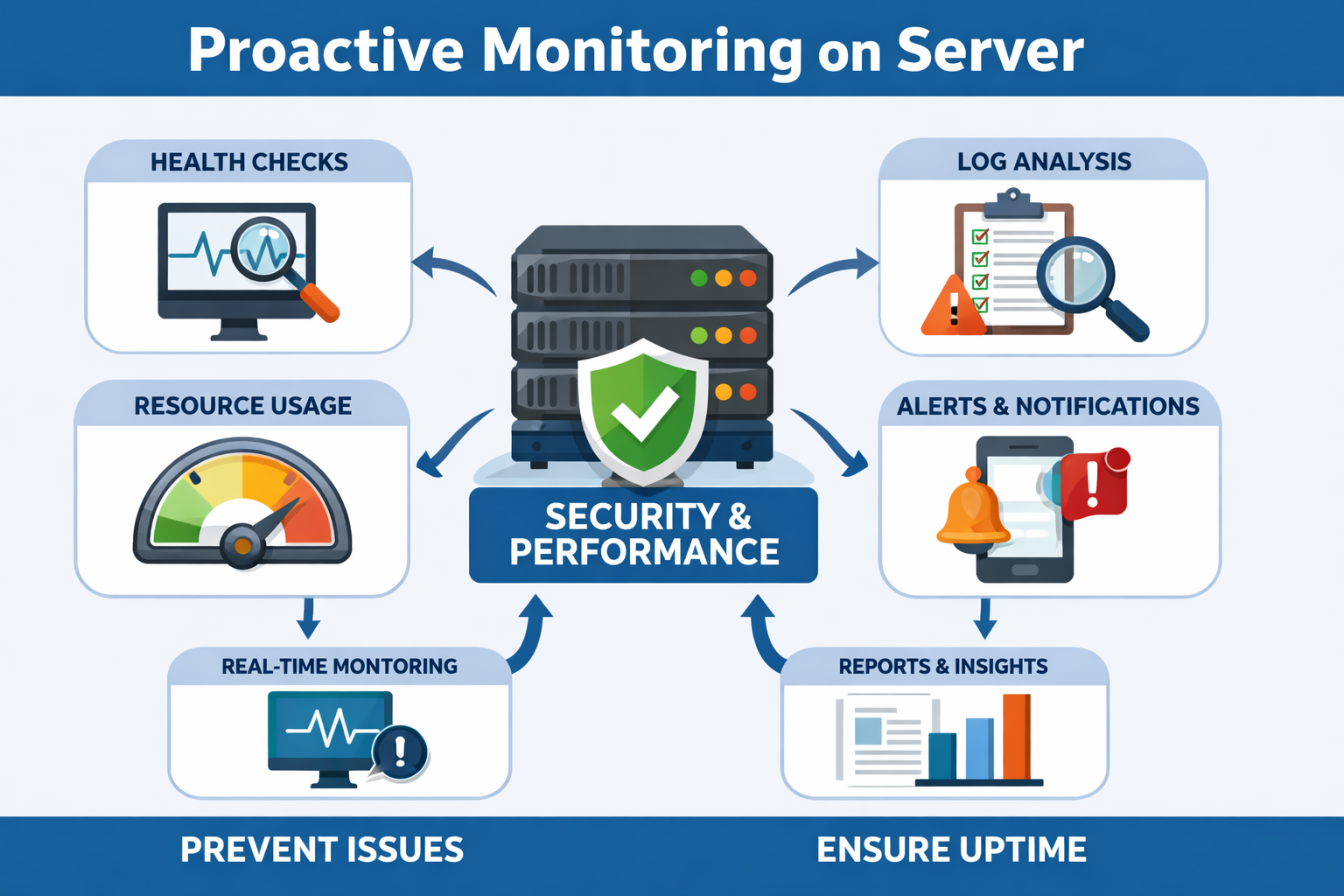
Proactive monitoring is a preventive monitoring strategy that continuously tracks server performance, system health, and application metrics to identify potential issues before they impact users or services.
This approach relies on automated tools, thresholds, predictive analytics, and performance metrics to detect anomalies early.
Key Characteristics
- Continuous monitoring of system resources
- Early detection of abnormal behavior
- Preventive alerts and automated actions
- Trend analysis for future capacity planning
- Reduced downtime and improved service reliability
Common Metrics Monitored: CPU utilization, Memory consumption, Disk I/O performance, Network latency, Application response time and Log anomalies
Benefits: Prevents system outages, Improves server stability, Reduces emergency troubleshooting, Supports capacity planning, Enhances user experience
Example: A monitoring system detects that disk usage is approaching 85% capacity and sends an alert to administrators. The team expands storage before the disk becomes full, preventing service interruption.
2. What is Reactive Monitoring?
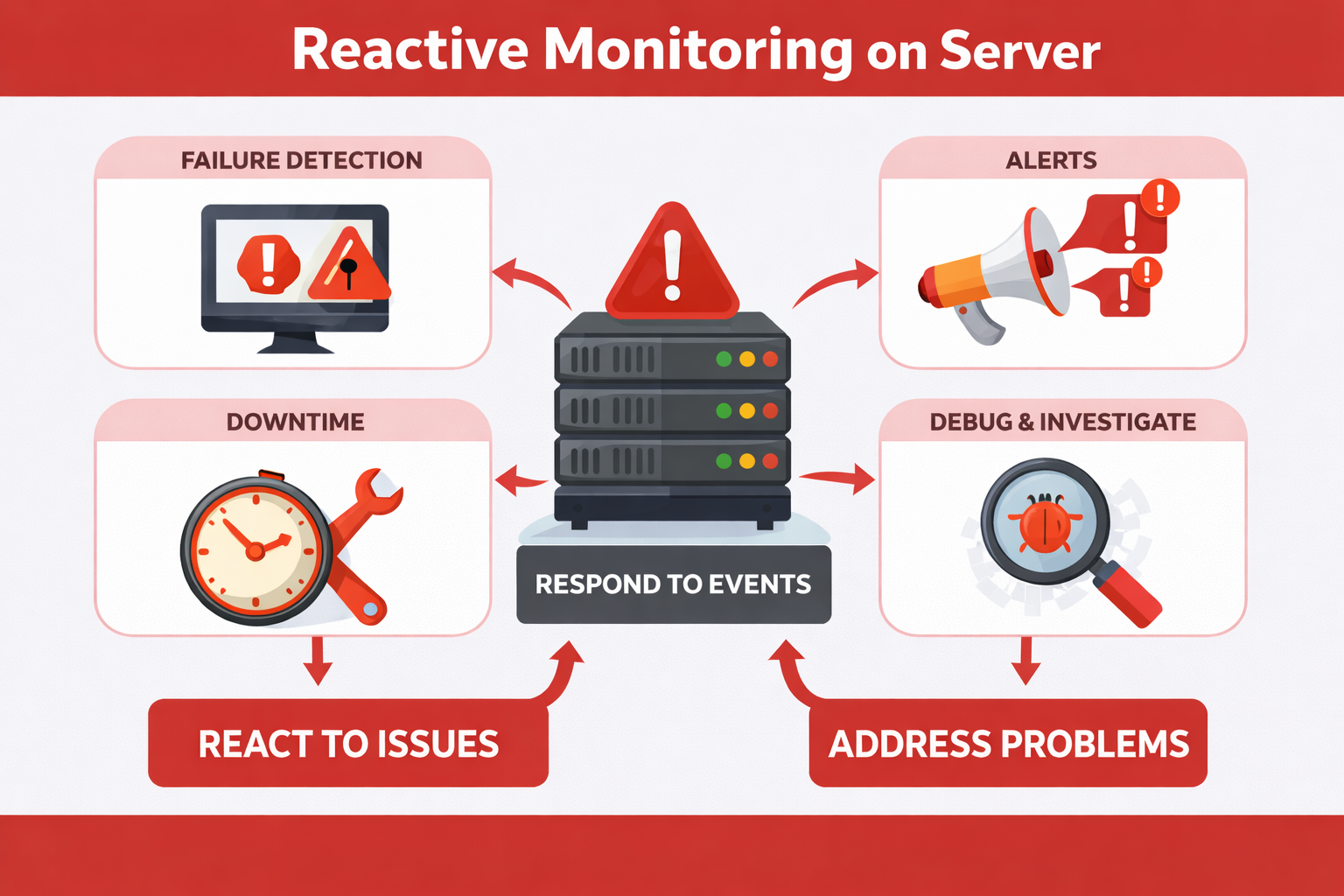
Reactive monitoring is a response-based monitoring approach where issues are addressed after they occur. Administrators typically become aware of problems when alerts trigger or users report service disruptions.
This method focuses on incident detection and troubleshooting rather than prevention.
Key Characteristics
- Monitoring triggered by failures
- Issue identification after system impact
- Manual investigation and resolution
- Limited predictive analysis
Typical Indicators: Service downtime. Application crash notifications, Error logs, User complaints and System alerts after threshold breach
Benefits: Simpler implementation, Lower initial monitoring complexity and Useful for small or non-critical systems.
Limitations: Increased downtime, Delayed issue detection, Higher operational risk and Reactive troubleshooting workload.
Example: A website becomes unavailable because the server CPU reached 100% utilization. Administrators receive an alert after the service failure and begin investigating the root cause.
Key Differences Between Proactive and Reactive Monitoring
|
Feature |
Proactive Monitoring |
Reactive Monitoring |
|
Monitoring Approach |
Preventive |
Response-based |
|
Issue Detection |
Before failure |
After failure |
|
System Impact |
Minimal or none |
Service disruption likely |
|
Downtime |
Reduced |
Higher risk |
|
Operational Strategy |
Predict and prevent |
Detect and fix |
|
Resource Management |
Optimized |
Often delayed |
|
Automation |
High |
Limited |
Conclusion
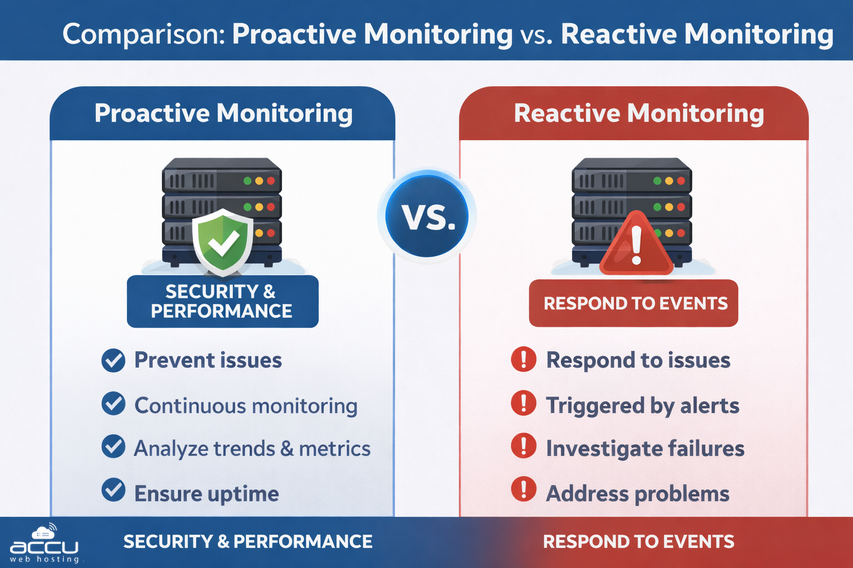
Proactive monitoring and reactive monitoring represent two different strategies for managing server infrastructure.
- Proactive monitoring focuses on prevention and predictive analysis.
- Reactive monitoring focuses on responding to failures after they occur.
For modern infrastructure where uptime and performance are critical, proactive monitoring plays a vital role in maintaining system reliability. However, reactive monitoring remains necessary for handling unexpected incidents. Organizations that implement proactive monitoring with reactive response capabilities achieve the most effective and resilient IT operations.