
Cybersecurity has become one of the most critical components of modern digital infrastructure. Organizations today operate in highly connected environments that include cloud platforms, remote users, mobile devices, APIs, Internet of Things (IoT) systems, and third-party integrations. This expansion has significantly increased the attack surface. At the same time, cyber threats have become more frequent, automated, and sophisticated.

Automation in cybersecurity refers to the use of technology to perform security tasks with minimal human intervention. It enables faster detection, consistent response, reduced operational burden, and improved overall resilience. This article explores the role of automation in cybersecurity, its applications, benefits, challenges, and future direction.
Understanding Cybersecurity Automation
Cybersecurity automation involves the use of software tools, artificial intelligence (AI), machine learning (ML), scripts, and orchestration platforms to perform security operations automatically.
Automation can operate at multiple levels:
-
Task automation (e.g., scanning systems for vulnerabilities)
-
Workflow automation (e.g., triaging and escalating alerts)
-
Decision automation (e.g., blocking malicious IP addresses)
-
Full incident response automation (e.g., isolating infected endpoints)
Automation does not replace cybersecurity professionals. Instead, it enhances their capabilities by eliminating repetitive tasks and allowing them to focus on strategic and complex activities.
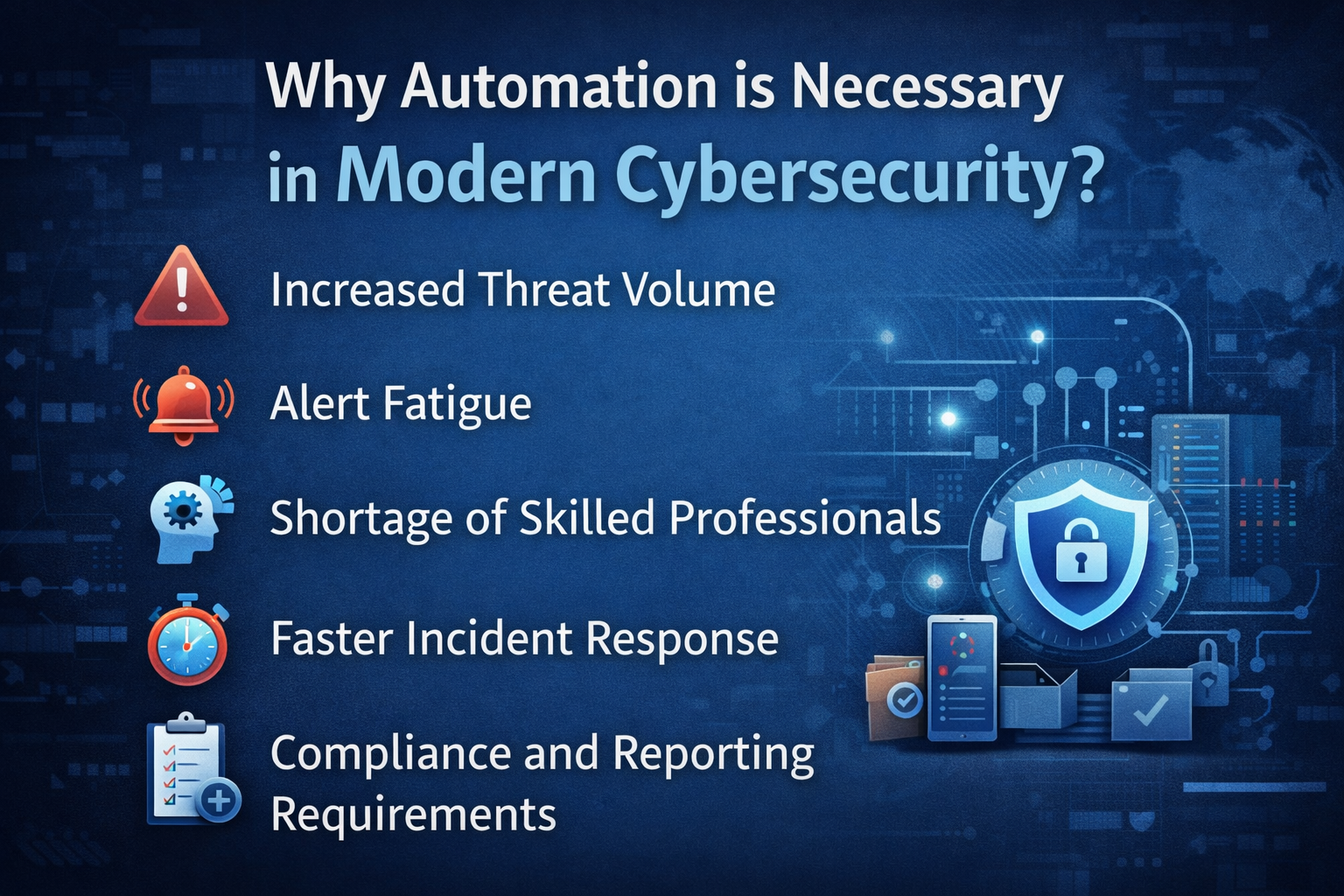
Why Automation is Necessary in Modern Cybersecurity?
1. Increased Threat Volume: Cyberattacks occur continuously. Attackers use automated tools to scan networks, brute-force credentials, exploit vulnerabilities, and distribute malware. Defensive strategies must match this speed. Manual monitoring cannot keep up with automated threats.
2. Alert Fatigue: Security systems generate large volumes of alerts. Many of these alerts are false positives. Analysts spend significant time investigating benign events. Automation helps filter, prioritize, and correlate alerts to reduce fatigue.
3. Shortage of Skilled Professionals: There is a global shortage of cybersecurity professionals. Automation compensates for limited human resources by handling routine security tasks.
4. Faster Incident Response: The time between detection and response determines the impact of an attack. Automated systems can react in seconds, while manual responses may take hours.
5. Compliance and Reporting Requirements: Regulations require continuous monitoring, documentation, and reporting. Automation ensures consistent policy enforcement and accurate audit trails.
Key Areas Where Automation Plays a Role
1. Threat Detection and Monitoring
Modern security operations centers (SOCs) rely on automation to monitor network traffic, endpoints, and cloud environments. Automated systems Analyze logs in real time, Detect abnormal behavior, Identify indicators of compromise (IoCs) and Correlate events across systems. Machine learning models enhance detection by identifying deviations from baseline behavior. This enables early detection of unknown or zero-day threats.
2. Security Information and Event Management (SIEM)
SIEM platforms collect and analyze security logs from multiple sources. Automation within SIEM systems performs Log aggregation, Pattern matching, Alert generation and Event correlation. Without automation, reviewing millions of log entries daily would be impossible.
3. Security Orchestration, Automation, and Response (SOAR)
SOAR platforms automate incident response workflows. When an alert is triggered, the system can automatically Gather contextual information, Enrich threat intelligence, Block malicious IP addresses, Disable compromised accounts and Isolate infected devices. This reduces mean time to respond (MTTR) and ensures consistent incident handling.
4. Vulnerability Management
Organizations must continuously identify and remediate vulnerabilities. Automation enables Scheduled vulnerability scanning, Risk scoring, Patch prioritization and Automated patch deployment. Automation ensures vulnerabilities are not overlooked due to manual errors.
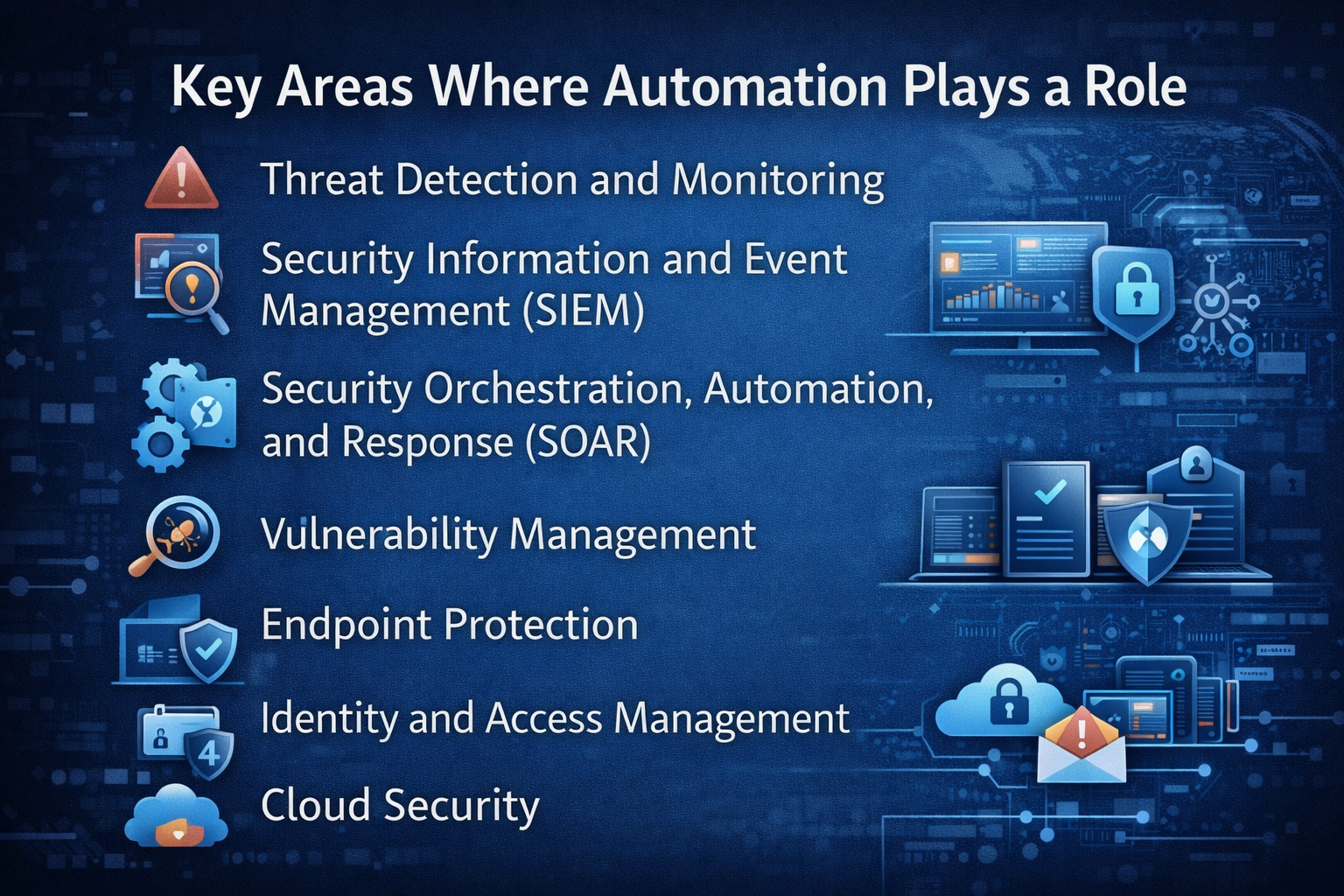
5. Endpoint Protection
Modern endpoint detection and response (EDR) systems automatically Detect malicious processes, Terminate suspicious applications, Quarantine infected files and Isolate endpoints from the network. Automated endpoint protection significantly reduces lateral movement in case of compromise.
6. Identity and Access Management (IAM)
Automation improves access control by Automatically provisioning user accounts, Enforcing multi-factor authentication (MFA), Removing access when employees leave and Detecting unusual login behavior. This reduces risks from insider threats and credential misuse.
7. Cloud Security
Cloud environments are dynamic. Resources are created and destroyed frequently. Automation is critical for Continuous configuration monitoring, Detecting misconfigurations, Enforcing security policies and Automated compliance checks. Cloud security posture management (CSPM) relies heavily on automation.
8. Email Security
Email remains a major attack vector. Automated systems can Detect phishing attempts, Analyze attachments in sandbox environments, Block malicious domains and Quarantine suspicious messages. Automation helps protect users from social engineering attacks.
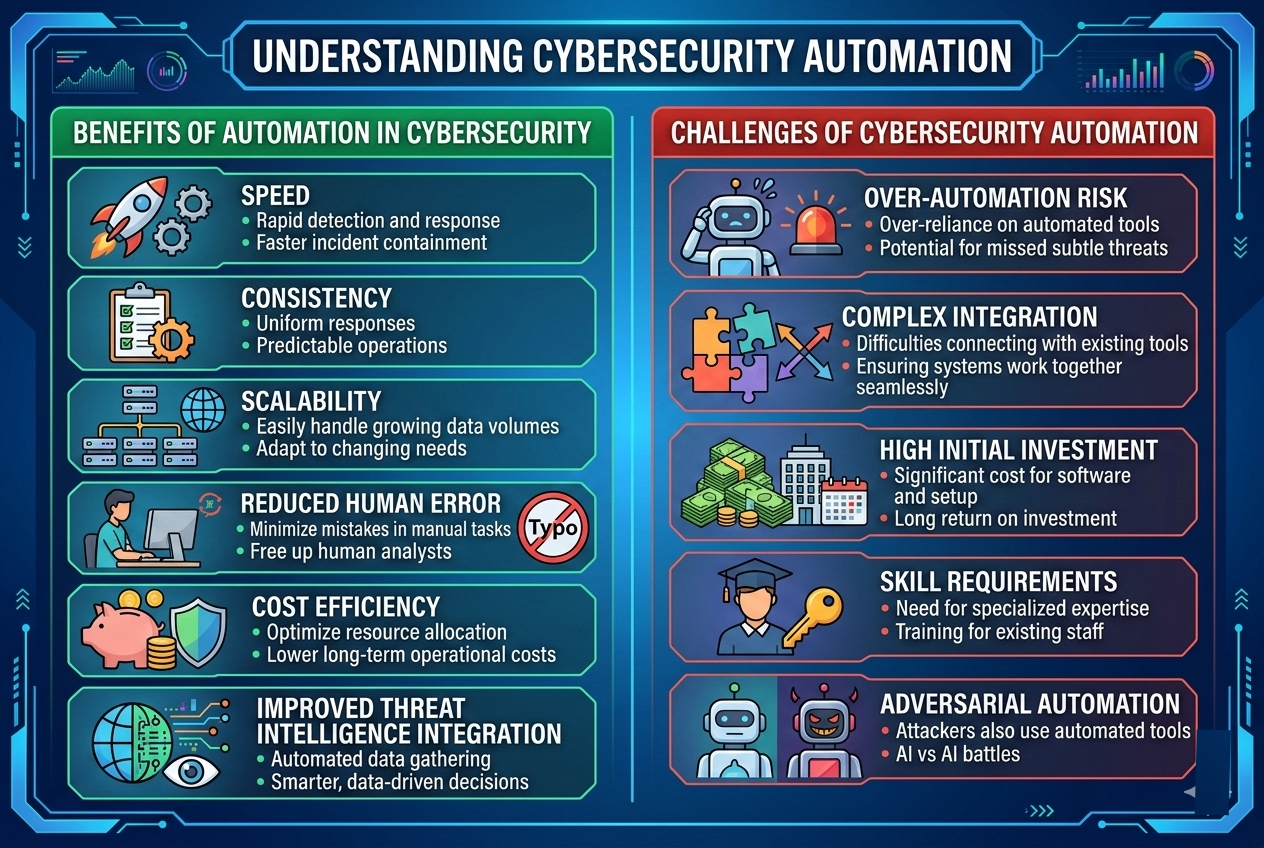
Benefits of Automation in Cybersecurity
1. Speed: Automated systems operate in real time. They can detect and respond to threats within seconds. Speed is critical in preventing damage.
2. Consistency: Human analysts may respond differently to similar incidents. Automation ensures standardized procedures are followed every time.
3. Scalability: As organizations grow, automation scales without proportional increases in staffing.
4. Reduced Human Error: Manual processes are prone to mistakes. Automation reduces configuration errors and oversight.
5. Cost Efficiency: Although automation tools require investment, they reduce long-term operational costs by improving efficiency.
6. Improved Threat Intelligence Integration: Automated systems can continuously ingest and apply global threat intelligence feeds.
Automation and Artificial Intelligence
Artificial intelligence enhances cybersecurity automation. AI enables systems to:
-
Detect unknown threats
-
Analyze large datasets
-
Identify attack patterns
-
Predict potential vulnerabilities
Machine learning models adapt over time, improving detection accuracy.
However, AI must be carefully managed. Poorly trained models can produce false positives or miss threats.
Challenges of Cybersecurity Automation
Despite its benefits, automation presents challenges.
1. Over-Automation Risk: Not all security decisions should be automated. Fully automated responses may disrupt business operations if misconfigured.
For example:
-
Automatically disabling user accounts may block legitimate users.
-
Blocking IP ranges could impact customers.
Human oversight remains essential.
2. Complex Integration: Organizations use multiple security tools. Integrating them into a unified automated workflow can be technically complex.
3. High Initial Investment: Advanced automation platforms require Licensing costs, Infrastructure resources, and Skilled implementation teams.
4. Skill Requirements: Automation does not eliminate the need for skilled professionals. It requires expertise in Scripting, Security architecture, Workflow design and Threat analysis.
5. Adversarial Automation: Attackers also use automation. They deploy automated botnets, scanning tools, and AI-driven phishing campaigns. Defensive automation must continuously evolve.
Future of Automation in Cybersecurity
Automation will continue evolving in several areas:
1. Autonomous Security Operations: Advanced systems will manage detection and response with minimal human involvement.
2. Predictive Threat Intelligence: AI-driven models will predict potential attacks based on behavioral patterns.
3. Adaptive Security Policies: Security controls will dynamically adjust based on risk level.
4. Integration with Blockchain and Identity Systems: Decentralized identity and blockchain verification may enhance automated trust validation.
Conclusion
Automation has become a fundamental component of modern cybersecurity strategy. The scale and complexity of digital infrastructure make manual security operations insufficient. Automation enhances detection speed, improves response consistency, reduces operational burden, and strengthens overall resilience.
However, automation is not a replacement for human expertise. It is a force multiplier. The most effective cybersecurity frameworks combine intelligent automation with skilled professionals.