
Introduction:
Web applications are increasingly vulnerable to a wide range of security threats. While traditional security measures can handle known attack methods, they often struggle to keep up with more advanced and constantly changing cyber threats. This is where Artificial Intelligence (AI) comes in, offering smart, adaptable protection that evolves to meet new challenges in web security.
In this article will explain how AI-powered Web Application Firewalls (WAFs) are changing the way we protect against web injection attacks and improving overall web application security.
What is a Web Application Firewall (WAF)?
A Web Application Firewall (WAF) is a security tool that helps monitor, filter, and block traffic between a web application and the internet. It acts as a shield, carefully inspecting all incoming and outgoing requests to identify and stop harmful activities before they can affect the application.
How Traditional WAFs Work?
Traditional WAFs typically use three main methods to protect web applications:
1. Signature-Based Detection: This method compares incoming traffic against a database of known attack patterns (called "signatures"). While it’s effective at spotting known threats, it can struggle with new or modified attacks.
2. Rule-Based Filtering: This method uses predefined rules to block traffic that meets specific criteria. These rules need to be manually set up and maintained by security teams.
3. Whitelist/Blacklist Approach: This method relies on lists of trusted or blocked IP addresses, domains, or patterns to filter traffic.
What is an AI-Based Web Application Firewall?
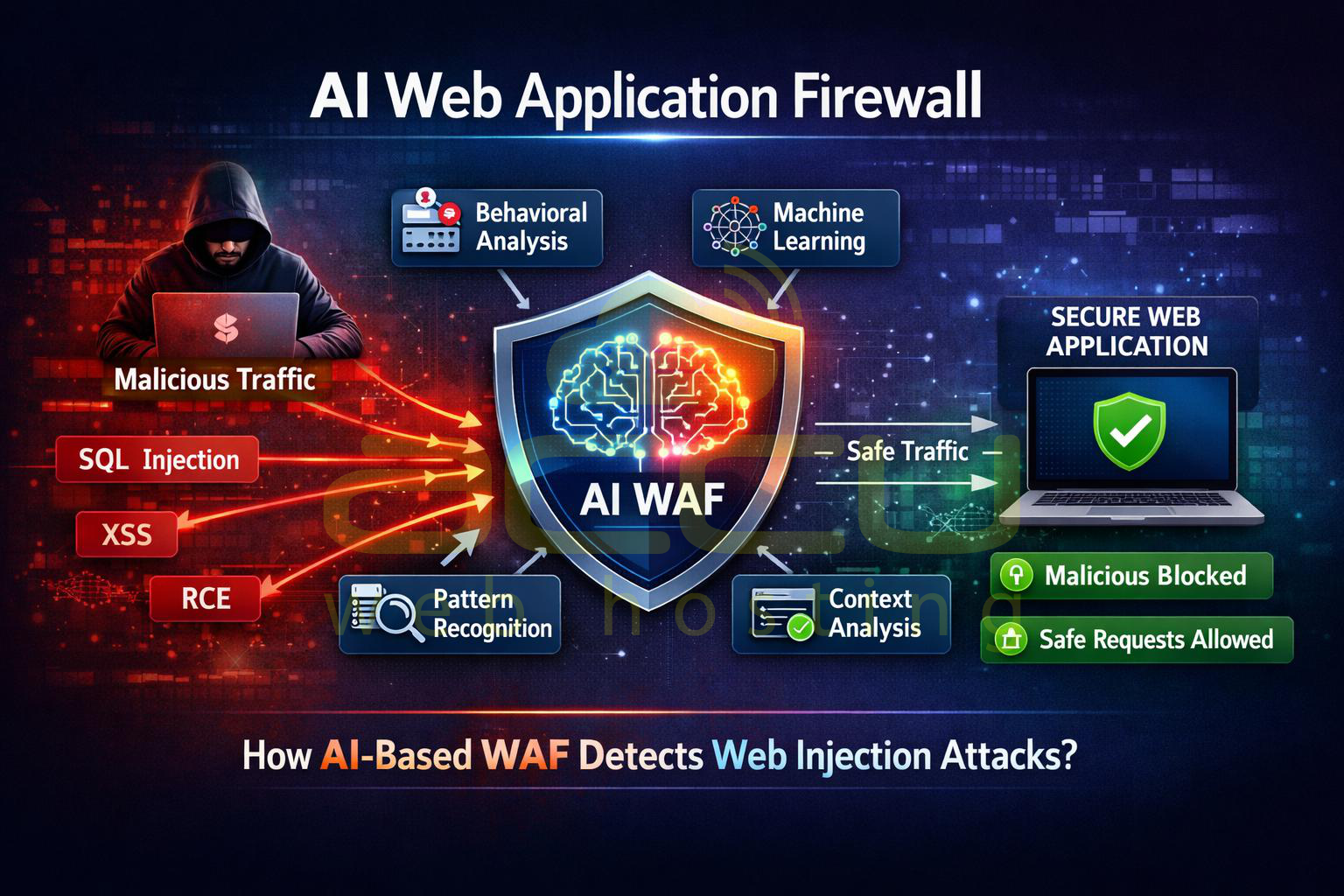
An AI-powered WAF uses machine learning and other AI technologies to offer smarter, more flexible protection. Unlike traditional WAFs, which depend on fixed rules, AI WAFs continuously learn from traffic patterns and user behavior. They adapt to new threats and improve their detection over time.
Key Components of AI WAF:
Machine Learning Engine: This is the heart of the AI WAF, where patterns are analyzed, anomalies are detected, and real-time security decisions are made.
Behavioral Analysis System: This system learns what normal application behavior looks like and identifies when something unusual happens.
Anomaly Detection Module: This component looks for any behavior that deviates from the normal patterns and flags it as suspicious.
Automated Response System: Based on the severity of the threat, this system can take action, log activity, or block harmful requests.
Continuous Learning Mechanism: The WAF keeps updating its model based on new threats and feedback, improving its protection.
Why Traditional WAFs Are Not Always Enough?
Traditional WAFs rely on:
-
Static rules
-
Known attack signatures
-
Manual rule updates
While effective in some cases, traditional WAFs have limitations:
-
They may not catch "zero-day" attacks (brand new, unknown threats).
-
They can miss hidden attacks.
-
They often result in many false positives.
-
They require manual tuning and maintenance.
As attackers continue to change their tactics, AI-based WAFs offer a solution by adapting to these evolving threats.
How AI-Based WAF Detects Web Injection Attacks?
1. Deep Packet Inspection with Neural Networks:
AI-based WAFs use deep learning models to carefully analyze HTTP and HTTPS traffic. Unlike traditional systems that rely only on simple keyword matching, AI can:
-
Understand the meaning of a request, not just the text
-
Detect hidden or encoded injection attempts
-
Identify attacks that change their format but still have malicious intent
This allows AI WAFs to catch more advanced and disguised threats.
2. Using Natural Language Processing (NLP) to Detect SQL Injection:
AI WAFs use Natural Language Processing (NLP) to better understand SQL queries and detect injection attempts.
They can:
-
Analyze SQL syntax to find suspicious or malformed queries
-
Detect intent to determine whether a query is legitimate or malicious
-
Check the context to see if the query matches normal application behavior
Example:
A traditional WAF might miss an obfuscated attack like:
' OR '1'='1' --
An AI WAF, however, understands the logical structure and intent of the query even if the attacker changes spacing, capitalization, or encoding.
3. Behavioral Anomaly Detection:
AI WAFs learn what normal user and application behavior looks like. If something unusual happens, it raises an alert.
They monitor:
-
User behavior patterns (for example, admin vs. regular user activity)
-
Normal application flow (typical login and navigation steps)
-
Request volume and frequency (detecting sudden spikes from bots or attack tools)
If behavior does not match the usual pattern, the request may be blocked.
4. Detecting Evasion Techniques:
Attackers often try to bypass security by hiding their payloads. AI WAFs can detect:
-
Encoded payloads (URL encoding, Unicode, Base64, hex, etc.)
-
Fragmented attacks are split across multiple requests
-
Slow, time-based attacks designed to avoid detection
Because AI focuses on behavior and structure, it can identify these tactics more effectively than traditional systems.
5. Multi-Layer Detection Approach:
AI WAFs use multiple layers of protection for stronger security:
-
Input Validation Layer: Checks if input matches expected formats
-
Semantic Analysis Layer: Understands the meaning of the request
-
Behavioral Analysis Layer: Compares activity to normal behavior
-
Reputation Analysis Layer: Reviews the trust level of IP addresses and domains
-
Response Analysis Layer: Monitors application responses for signs of exploitation
This layered approach improves detection accuracy and reduces false positives.
Real-World Example
Scenario:
An attacker tries a complex SQL injection attack on a login form.
Attack Payload:
username: admin' UNION SELECT NULL, NULL, password FROM users WHERE username='admin'--
Traditional WAF Response:
-
May detect basic SQL keywords
-
Could be bypassed if the payload is encoded
-
May generate false positives
AI WAF Response:
-
Analyzes the SQL structure and detects a UNION-based injection pattern
-
Notices unusual behavior
-
Detects the attack even if it is encoded or modified
-
Understands that legitimate users do not create such queries
-
Blocks the request with high confidence and logs detailed information
By combining intelligent analysis, behavior monitoring, and multi-layer detection, AI WAFs provide stronger and more reliable protection against advanced injection attacks.
Conclusion:
By using machine learning and behavioral analysis, AI-based WAFs can detect suspicious activity more accurately, reduce false positives, and require less manual configuration.
As cyber threats continue to evolve, AI WAFs can learn and adapt to new attack patterns, helping keep web applications protected from both known and emerging risks. Organizations aiming to strengthen their security should consider adding an AI-powered WAF as part of a well-rounded security strategy.