

Most online income is transactional: complete a project, send an invoice, and start searching for the next client. Reseller hosting changes that model by creating predictable recurring revenue. When clients pay monthly or annually to keep their websites online, you continue to earn from the same customer over time.
That recurring structure is what makes reseller hosting one of the most practical long-term online business opportunities for freelancers, agencies, developers, and entrepreneurs.
This guide explains how to build, manage, and scale a reseller hosting business - from choosing your first reseller plan to creating hosting packages and growing a stable client base.
What Makes Reseller Hosting a Strong Recurring Revenue Model?
Web hosting is not a one-time purchase. Businesses need their websites, email, and applications to be online at all times, making hosting an ongoing service rather than a temporary expense. As long as a client continues using their website, they continue paying for hosting.
With reseller hosting, you purchase server resources from a provider like AccuWeb Hosting and sell hosting services under your own brand. Your clients interact with your business while AccuWeb manages the backend infrastructure, server maintenance, uptime, and security.
This model gives you several advantages:
- White-label hosting allows you to sell services under your own company name.
- Predictable monthly costs make it easier to calculate profit margins.
- Scalable reseller plans let you grow your business as your client base expands.
- No server management required means you can focus on clients, support, and growth instead of infrastructure.
Because your hosting costs remain relatively stable while your client base grows, each additional customer increases your recurring monthly revenue and long-term profitability.
Step-by-Step: How to Build Recurring Income
1. Start with the Right Reseller Plan
The first step in building a hosting business is choosing a reseller plan that matches your current goals and budget. A good starting plan should provide enough resources to host your first few clients while keeping your costs manageable. As your customer base grows, your hosting plan should be flexible enough to scale alongside your business.
Choosing Your Starting Point
You don’t need to invest in a large hosting package right away. Starting with a smaller, resource-focused reseller plan allows you to launch your business with lower risk and increase your investment only when your client base expands.
Ways to Optimize Your Plan Selection:
- Start with a plan that fits your current needs: Choose a reseller package that offers enough cPanel accounts, storage, and bandwidth to support your first few clients without overpaying for unused resources.
- Scale gradually as your business grows: As you onboard more customers and approach your account or resource limits, you can upgrade to a larger reseller plan with higher capacity.
- Maximize your existing resources: Each cPanel account can host multiple websites using add-on domains, helping you serve more clients efficiently before upgrading.
- Monitor resource usage regularly: Keep track of disk space, bandwidth, and account usage so you can expand your plan before performance issues affect your clients.
- Use professional tools from day one: Even entry-level reseller plans typically include WHM access and white-label hosting features, allowing you to present your services under your own brand from the beginning.
By starting with the right-sized reseller plan, you reduce upfront costs while keeping your business ready for future growth. This approach helps you build recurring income steadily and sustainably without unnecessary financial pressure.
2. Build Packages Clients Can Actually Understand
Most clients don't care about disk quotas, inode limits, or server specifications. They care about whether their website stays online, loads quickly, and remains secure. That's why your hosting packages should focus on business outcomes rather than technical details.
A simple three-tier structure works well for most reseller hosting businesses:
Starter - For Small Business or Personal Websites
Ideal for brochure websites, portfolios, and new businesses that need a reliable online presence. Focus on speed, uptime, and ease of management rather than resource limits.
Business - For Growing Websites
Designed for businesses with higher traffic, content-heavy websites, or multiple service pages. Position this tier for better performance, daily backups, and long-term reliability.
Pro - For eCommerce or High-Traffic Websites
Built for revenue-generating websites that cannot afford downtime or slow loading speeds. Premium performance, advanced security, and priority-level support make this tier easier to price at higher margins.
Keep your package names simple and your messaging benefit-driven. Clients should immediately understand which plan fits their business without needing technical explanations.
Take a look at our web hosting plans - clearly explaining the right solution for every type of website.
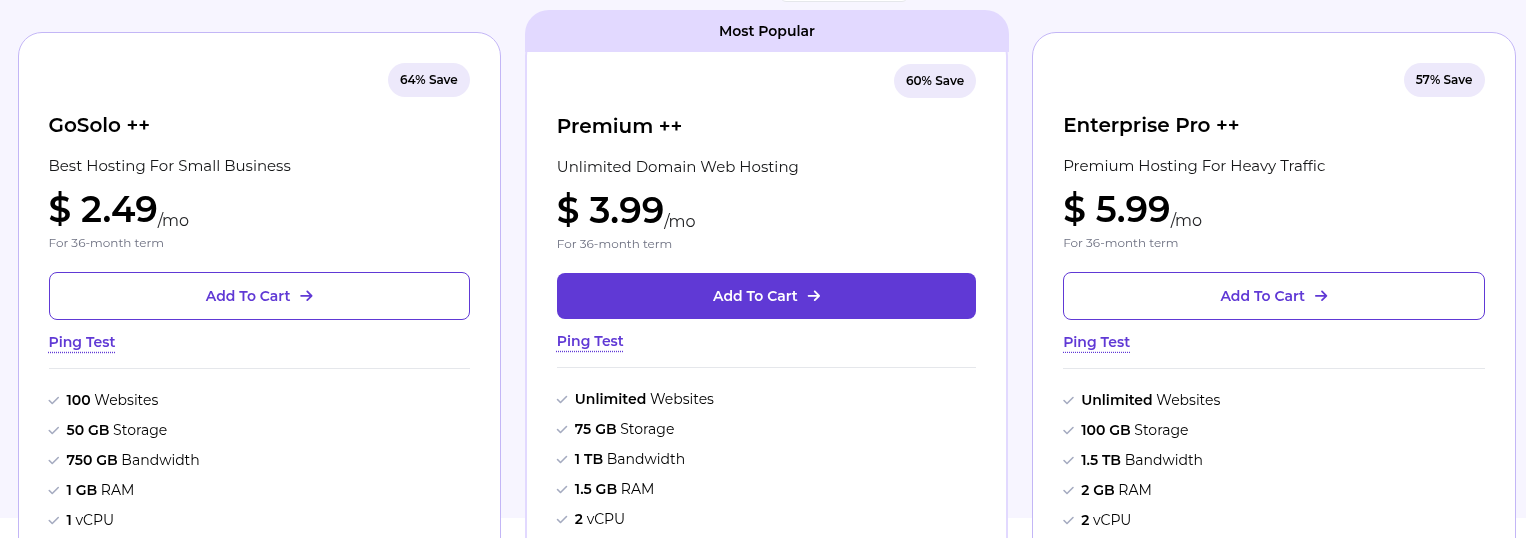
At the end of the day, clients are not buying server space - they're buying peace of mind. By focusing on reliability, security, speed, and support instead of raw technical specifications, you position your hosting services as a premium solution rather than a low-cost commodity.
3. Bundle Hosting with Existing Services
If you are a freelancer, web developer, digital agency, or SEO provider, reseller hosting can easily become an additional source of recurring income alongside your existing services.
Instead of sending clients to a third-party hosting provider, you can offer hosting as part of a complete website solution. Most clients prefer working with a single provider who can manage everything related to their website rather than dealing with multiple companies for hosting, maintenance, and support.
Bundling hosting with your services also increases client retention. Once a client's website, hosting, updates, and support are all managed by you, switching providers becomes far less convenient. This creates stronger long-term client relationships and more stable recurring revenue for your business.
Some practical bundle ideas include:
- Website design + hosting package
- Hosting + monthly maintenance and updates
- SEO services + hosting + technical support
- eCommerce development + managed hosting
- WordPress care plans with hosting included
Bundled services also shift the conversation away from low-cost hosting comparisons. Instead of competing on server space or pricing alone, you position yourself as a complete website solution provider delivering reliability, convenience, and ongoing support.
By offering hosting as part of a broader service package, you create more value for clients while building predictable monthly income for your business.
4. Price for Margin, Not Just Coverage
Your reseller plan costs a fixed monthly amount. Once your clients' combined payments exceed that amount, you're profitable. Every client beyond that point increases your margin without increasing your infrastructure cost.
A rough illustration:
- Suppose your reseller plan costs $30/month
- You host 10 clients at
- 15/month each - that′s
- 150/month gross
- After plan cost: $120/month recurring profit from a single plan tier
- At 20 clients across an upgraded plan, the same logic applies on a larger scale
A few principles to apply when setting prices:
Don't undercut local agencies - price at or above market rate for managed hosting. You're providing support, not just disk space.
Charge annually when possible. Offer a small discount (equivalent to one free month) and collect 12 months upfront - better for your cash flow, and it reduces churn.
Bill for value-added work separately. Migrations, SSL troubleshooting, or plugin updates shouldn't be absorbed into your hosting fee.
5. Focus on Client Retention
Building recurring income isn't only about getting new clients - it's about keeping the ones you already have. In reseller hosting, long-term customers are what create stable and predictable monthly revenue.
The biggest threat to recurring income is client churn. If a customer leaves because of downtime, slow performance, or poor support, you lose both recurring revenue and potential referrals. That’s why delivering a reliable hosting experience should always be a top priority.
A strong hosting foundation helps you retain clients by reducing problems before they happen. With AccuWeb Hosting, many of the essential reliability features are already built into the platform:
- 99.9% uptime guarantee helps ensure client websites remain online and accessible around the clock.
- LiteSpeed web server with LSCache improves website speed and performance, which benefits both user experience and SEO rankings.
- Free daily backups allow you to quickly restore websites if a client accidentally breaks something or a plugin update causes issues.
- DDoS protection and spam filtering help block common security threats before they impact client websites.
- Free website migrations make it easier to onboard new clients without technical complications.
Beyond infrastructure, responsive communication also plays a major role in retention. Quick support responses, proactive updates, and reliable service build trust over time and help separate your business from larger, less personal hosting providers.
A happy client is a long-term client - and long-term clients are the foundation of sustainable recurring revenue.
6. Automate the Administrative Work
As your client base grows, handling billing, account creation, and support tasks manually quickly becomes time-consuming. To keep your reseller hosting business scalable, you need automation tools that reduce repetitive work and simplify day-to-day management.
The goal of recurring income is simple: grow your revenue without increasing your workload at the same pace.
WHM (Web Host Manager)
WHM acts as the central management dashboard for your reseller hosting environment. From a single interface, you can:
- Create, suspend, or terminate cPanel accounts
- Monitor client resource usage
- Configure hosting packages
- Manage multiple client accounts efficiently
Most account management tasks can be completed in just a few clicks, making it easy to manage growing numbers of clients.
WHMCS or Blesta
Billing platforms like WHMCS and Blesta automate much of the client lifecycle. Once integrated with WHM, they can automatically:
- Generate invoices
- Collect recurring payments
- Create hosting accounts after signup
- Suspend overdue accounts
- Send renewal reminders
This allows new clients to sign up, pay, and receive hosting access without requiring manual setup from you.
One-Click Installers
Tools like Softaculous, included with cPanel, simplify website deployment by allowing clients to install WordPress, Joomla, Magento, and other applications in minutes instead of hours.
Why Automation Matters
By automating the administrative side of your hosting business, you free up more time to focus on marketing, customer relationships, and growing your client base. This efficiency ensures that as your recurring revenue increases, your workload remains manageable.
7. Scale the Infrastructure as the Business Grows
AccuWeb's reseller plans are designed to grow alongside your business. Upgrading from Bronze to Silver to Gold to Platinum is seamless - no migrations, no downtime, no client-side disruption.
As your client base matures, a few scaling paths are worth considering:
- Upgrade your reseller plan tier to accommodate more accounts and storage as you approach limits.
- Add a VPS reseller plan for clients who need dedicated resources - higher-value clients who run eCommerce or SaaS products often require this, and they'll pay accordingly.
- Leverage AccuWeb's 7 global data center locations (US, UK, Germany, Singapore, India, Australia, and more) to serve clients in specific regions with lower latency. This is particularly valuable if you work with international clients or agencies.
There's no ceiling that requires you to build your own infrastructure. The platform scales with you.
Who Should Consider Reseller Hosting?
Reseller hosting is most practical when you already have, or can realistically build, a client base that needs websites. That typically means:
Freelance web designers and developers who hand off finished sites to clients who then manage their own hosting - you can capture that recurring revenue instead.
Digital agencies that manage ongoing SEO, content, or paid media — adding hosting creates another monthly revenue line from existing relationships.
IT consultants or managed service providers who support small business clients — hosting fits naturally alongside email, domain management, and tech support.
Entrepreneurs looking for a low-overhead recurring income stream - if you're willing to handle basic client communication, the operational cost is minimal.
Final Thoughts
Reseller hosting doesn't require a large upfront investment, technical infrastructure expertise, or a dedicated sales team. It requires a client base that needs websites, a reliable hosting platform, and a pricing structure that covers your costs and leaves room for profit.
AccuWeb Hosting provides the infrastructure - 99.9% uptime SLA, LiteSpeed performance, daily backups, DDoS protection, WHM and cPanel access, free migrations, and a 30-day risk-free trial to get started without committing.
The rest is execution: pick a plan, build your packages, set a margin price, and deliver a reliable experience that keeps clients renewing month after month.
Start with AccuWeb's reseller hosting plans and see how quickly a few clients can become a meaningful recurring income stream.
Frequently Asked Questions
Is reseller hosting actually profitable?
Yes, when priced correctly. The key variable is the gap between your wholesale plan cost and your combined client billing. With 10 clients at reasonable rates, most resellers cover their plan cost within the first month of operation and are profitable from there.
Do I need technical experience to run a reseller hosting business?
Not significantly. WHM and cPanel are designed for non-engineers. For most client requests - email setup, WordPress installs, and domain pointing - cPanel handles it with a few clicks. Deeper technical issues (server-level problems, security incidents) are handled by AccuWeb's support team, not you.
Will my clients know they're on AccuWeb's infrastructure?
No. White-label branding means your clients see your company name, your nameservers, and your support contact details throughout. AccuWeb operates as the silent infrastructure provider.
What happens when I hit my plan's account limit?
You upgrade to the next tier- it's instantaneous and doesn't affect any existing site or client. AccuWeb's plan structure is designed specifically for this growth pattern.
How do I handle client support?
You handle the first-line client communication, which, for most hosting questions, is straightforward. AccuWeb manages the server infrastructure, so you're not troubleshooting hardware or network issues. WHMCS can also include a client portal with a knowledge base, which reduces inbound support volume significantly.
What's the best way to get my first clients?
Start with people you already work with. If you've built websites for clients, reach out and offer to migrate their hosting to your platform - often for a comparable or lower price, with the added value of your direct support. That initial group is your proof of concept and your first recurring revenue.